
The Art of Rope Handling: Where Real Skill Begins
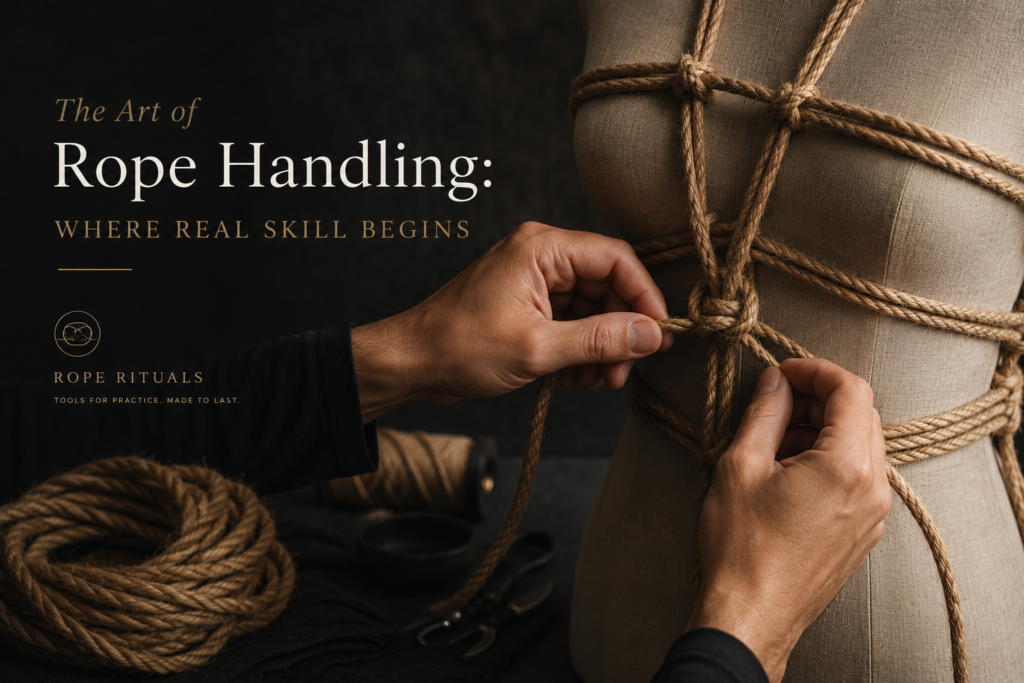
When most people begin learning Shibari, they naturally become fascinated by patterns.
A new harness, an elegant decorative tie, or an intricate suspension can feel like the next milestone to chase. With countless tutorials available online, it’s easy to believe that learning more patterns is the fastest way to improve.
But if you spend time around experienced practitioners, you’ll notice something different.
They’re rarely thinking about the pattern.
They’re thinking about the rope.
What Does It Mean to Have “Rope Hands”?
Over time, every experienced rigger develops what many affectionately call rope hands, a familiarity with the rope that goes far beyond knowing how to tie knots.
It’s the quiet confidence that comes from feeling how the rope moves through your fingers. It’s knowing how much tension is enough without having to think about it. It’s feeding rope smoothly, managing coils without tangles, and making small adjustments almost instinctively.
These aren’t skills that can be memorized from a diagram. They’re built through repetition.
Much like a musician develops sensitivity to their instrument or a woodworker learns the feel of their tools, a rigger learns to understand the language of the rope through countless hours of practice.
Patterns Teach Technique. Practice Builds Skill.
There’s nothing wrong with learning new ties. In fact, exploring different patterns is part of what makes Shibari so engaging.
The mistake many beginners make is believing that complexity equals progress.
A beautifully tied chest harness doesn’t come from remembering every step in a tutorial. It comes from consistent tension, clean rope management, deliberate movements, and an awareness of the person being tied.
Someone with excellent rope handling can create an elegant experience using only a few simple ties. Someone with dozens of patterns but little rope control will often find even familiar ties becoming awkward or frustrating.
The difference isn’t knowledge.
It’s practice.
The Best Practice Doesn’t Always Need a Partner
Some of the most valuable training happens before another person is even involved.
Take time to simply handle your rope.
Practice coiling and uncoiling until it becomes effortless. Feed the rope smoothly from one hand to the other. Work on maintaining even tension. Tie the same knot repeatedly until your fingers no longer have to search for the next movement.
It may not feel exciting, but these quiet exercises develop habits that carry into every future tie.
They’re the foundation upon which everything else is built.
Slow Is Not the Opposite of Good
One of the biggest misconceptions among beginners is that experienced riggers work quickly.
In reality, they often work with remarkable patience.
Every movement is intentional. Every adjustment has a purpose. Rather than rushing to finish a pattern, they’re paying attention to tension, communication, body positioning, and the comfort of their partner.
Ironically, slowing down is often what allows you to become faster in the long run.
Deliberate practice creates consistency, and consistency eventually becomes confidence.
When Your Hands Know the Rope
Perhaps the greatest gift of developing rope hands is that, eventually, you stop thinking about the mechanics altogether.
Your attention shifts away from managing the rope and toward the person in front of you. You become more present in the interaction, more aware of subtle responses, and more capable of adapting your tying to the moment rather than simply following a sequence of steps.
That is where Shibari begins to feel less like tying knots and more like creating an experience.
A Rope That Grows With You
As your handling improves, you’ll begin to notice qualities in your rope that once seemed insignificant.
Its texture. Its flexibility. The way it responds under tension. The way a well-prepared natural jute rope softens, settles, and develops character through regular use.
These are details that reveal themselves only through practice.
In many ways, your rope grows alongside you.
So before chasing the next complicated pattern, spend some time developing your rope hands.
Because beautiful Shibari isn’t measured by how many ties you know.
It’s measured by how naturally, intentionally, and confidently you can bring a single length of rope to life.