
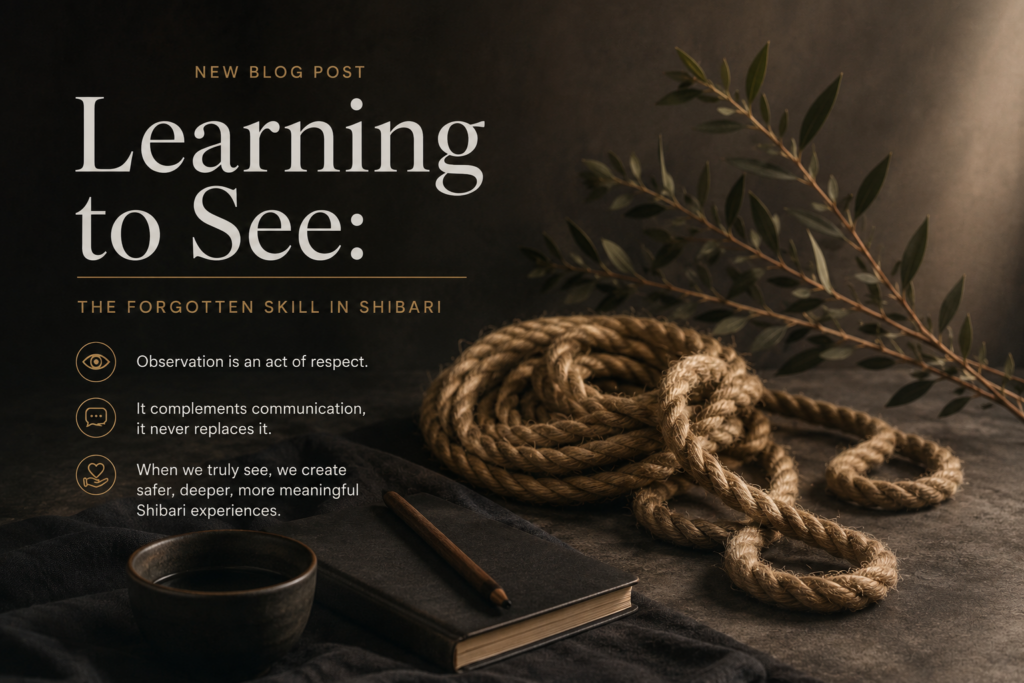
Learning to See: The Forgotten Skill in Shibari
Most people begin their Shibari journey by learning where to place the rope.
Very few are taught where to place their attention.
Knots, frictions, harnesses, suspensions, these are often the first things people focus on when learning Shibari. Technical skill is important. It provides structure, safety, and a foundation to build upon.
But there is another skill that receives far less attention.
The ability to observe. Not simply to look, but to truly see.
A skilled practitioner is not only aware of the rope in their hands; they are aware of the person within it.
Observation Is More Than Looking
Observation is an active practice. It is noticing subtle changes without jumping to conclusions. It is paying attention while remaining curious.
It means asking yourself:
- Has their breathing changed?
- Have they become noticeably quieter or more talkative?
- Has their posture shifted?
- Do they appear relaxed, or are they holding unnecessary tension?
- Has the energy between us changed?
These observations are not answers. They are invitations to check in.
Observation Never Replaces Communication
One of the biggest misconceptions in Shibari is the belief that experienced practitioners can simply “read” another person.
They cannot.
People express discomfort, excitement, nervousness, and vulnerability in different ways. A smile may hide uncertainty. Silence may reflect peace (or hesitation).
Observation helps us recognize that something may have changed. Communication helps us understand what that change means.
The two should always work together.
The Rope Often Changes the Conversation
Many negotiations begin before a single knot is tied. Yet experiences evolve.
As the scene unfolds, emotions may surface unexpectedly. Confidence may grow. Boundaries may become clearer. New sensations may emerge. A practitioner who remains observant recognizes that a negotiation is not simply a conversation that happened before the scene.
It is something that continues throughout it.
Presence Can Be Felt
Most people will not remember every knot that was used. They are far more likely to remember how present you were.
Did you seem rushed?
Distracted?
Focused on creating the perfect pattern?
Or did they feel that your attention never left them?
Presence is difficult to photograph. Yet it is often the quality people remember most.
Observation Begins With Yourself
Learning to observe does not stop with another person. It also means noticing your own state.
Are you trying to impress? Are you rushing because people are watching?
Have you stopped listening because you are focused on finishing the tie?
The quality of your attention shapes the quality of the experience.
A Skill That Never Ends
Technical knowledge can be measured. Observation cannot.
There is no final lesson where someone becomes an expert at paying attention.
Every person is different. Every scene is different. Every interaction offers another opportunity to become more aware.
Perhaps that is why observation remains one of the most valuable and most overlooked skill in Shibari.
Because no matter how much we learn, there is always something new to notice.
Final Thoughts
Beautiful Shibari is not defined solely by balanced patterns or elegant knots.
It is defined by the quality of attention we bring to another human being.
The rope may shape the body. But it is awareness that shapes the experience.